_edited_edited.jpg)
Nothing Left: Not Right

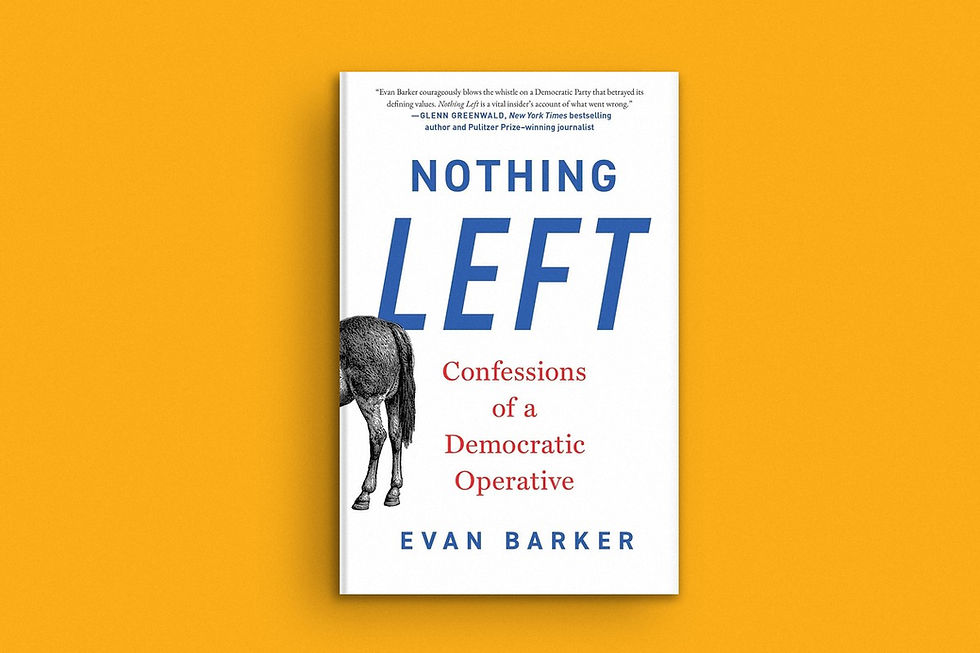
Nothing Left is Evan Barker’s attempt to explain her political trajectory, going from a young Obama campaign staffer to a fundraising director for progressives to a Trump voter. My arc is substantially similar, though I’m a bit younger and began with Clinton, then went to Bernie, and finally Donald John Trump.
Barker’s writing, with allusions to American film, is charming, not entirely amateur, and well edited. Nothing Left is a tight, 263-page memoir. It is better than other political memoirs I have reviewed this year that have similarly tried to trace the arc of a movement.
In Nothing Left, Barker gives the reader an interesting close-up of politicians and politics in the progressive movement, offering insights ranging from the personalities of people like Sanders and AOC to the inner psychological workings of the racially sensitive neurotics currently in charge of the left, some of whom have visited shamans to cope with their hatred of their white ancestors. If you are a lay reader without close familiarity with politics, this is a great book for you. I imagine you’ll enjoy her salacious gossip about Bernie’s disregard for people and AOC’s shyness as much as the political insights on how best to fundraise from donors.
I’d add this caveat: Barker never exactly spells out her critique of the left. For example, on immigration, she often admits that Democrats made mistakes. She never elaborates her own views, however: we don’t know if her primary problem with immigration is the attempt by Democrats to use immigration as an electoral tool (“demographics is destiny,” as she often says herself), we don’t know if her issue is rising crime, we don’t know if her issue is that her own white family is being left behind, and one suspects it’s all of these at once, and that Barker is simply averse to political discourse—or, remembering the lessons of her long career (which I suspect is not totally over)—doesn’t want to put too much in writing, lest she accidentally restrict her own future ambitions.
If you are familiar with politics, Nothing Left is helpful for a wholly different reason: understanding the messy reality of leftists moving right. Nothing Left ends with Barker unhappy with Democrats and Republicans. She speaks positively of Hawley and suggests the Republican Party embrace a public option. She identifies as an economic populist, which, fair, I did too for a time, after I left the left.
She entered politics inspired by Barack Obama. She never revisits this motivation, leading her to likely miss how Barack Obama made race relations worse in the United States and established much of the groundwork for DEI, Kamala, Biden, and the progressive takeover. My own first DEI class at USAID was led by an Obama appointee. Biden’s team overlapped heavily with Obama’s, as did Kamala’s. It is no accident that “woke” came after Obama: he made “woke” possible by bringing a certain type of race politics and liberalism into the Democratic Party. Greer covers this well in Whitepill. It’s not enough to leave “woke” behind; it’s critical to understand that “woke” was not an aberration of Democratic politics but its fulfillment. For example, Barker often references Democrats embracing the idea that “demographics is destiny,” but she never seems to grasp that demographic change is a mainline strategy in the Democratic Party, not an aberrant fluke of individual personalities. In many places, demographics is destiny. Take Mamdani; he lost among New York–born voters. He won in New York because of newcomers. Democrats are often right to bet on demographics. Why even bother winning over rural white people? To win elections? What for? What do Democrats aim to do with political power but pass amnesty, cementing their demographic strategy into the body politic?
Nothing Left leaves me with the uncomfortable notion that white identity and skin color matter, but with the sense that—but for being an ex-leftist—one could not express these feelings. One must possess these ex-leftist credentials to be a legitimate voice, because only then can others be sure this person isn’t racist, precisely reproducing purity politics on the right. I think this is a pleasant state of affairs for a large number of people, more or less “on the right,” who are broadly anti-woke (opposing transgender identification and frustrated with cancel culture and illegal immigration) but are hesitant to surrender the weapons that they use to police the rest of the right, namely, accusations of racism and identitarianism. Barker is enormously reluctant to fully commit to paper the fears she has for her own child, devoting just a few lines to the reality that her white son is public enemy number one for the progressive movement:
There was also something about having a white male child that made everything I had just experienced while working in leftist politics feel much more real. To them, my innocent baby was public enemy number one. Having witnessed white men become so denigrated in the progressive movement gave me a very real fear of the world my son would grow up in. It made everything more impactful. (p. 214)
There are people who would love it if the only people who could talk about voting to protect their white sons were millennial moms who voted for Bernie.
Whose Populism?
One could read this book and think whoever is the most economically populist simply wins. But this is a moment of history in which economic populism is only one vital aspect of the contestation of power, alongside identity and demographic strategy. For a time, I was in the same place Barker was at the end of Nothing Left, hoping for a conservative party with left-leaning economic policy. I am no longer, exactly, there. I am a single-issue voter on mass migration. After all, none of these policy debates matter if the demos is permanently lost.
Whichever party can figure out how to get every American healthcare while protecting our borders, reshoring our industrial base, and putting America and its citizens first, will become the permanent party of the working class. Economic populism and cultural moderation are where many American voters are. We need a party that meets them there. (p. 262)
Political prescriptions such as this simply read as naive. This prescription, though it pretends to be consultant advice for both parties, could realistically apply only to the Republican Party. Barker spends chapter after chapter telling us the Democrats engineered a cultural revolution, including against borders. So what are we to do? What about amnesty? What about the illegals already here? What about OPT (Optional Practical Training) and H-1B and the crushing, decades-long pattern of demographics actually being destiny? Sure—Latino men went to Trump—but almost every other ethnic “minority” did not. The most important national issue, migration, is conveniently left out. One can imagine Democrats taking this advice on a purely aesthetic level, faking moderation, while, as the joke goes, “voting like Mao.” This advice amounts to nothing substantive, but nevertheless could be a weapon against the right, wielded by both the left and certain factions of “the right” who would be more than glad to accuse others of being “woke right” and alienating moderates.
Finally: we should be wary of self-described populists, who often feel this title alone gives them the absolute right to speak for and interpret the desires of the populace. Is restricting birthright citizenship economically populist? What about the war in Iran? Many of the core political questions we face right now don’t map easily onto a “populist or not populist” axis. Economic populism is a poor political heuristic because it calls for a class of moralistic intermediaries to interpret what is best for the people—precisely the kind of person Barker describes as dominating the progressive movement. Furthermore, the notion that Trump won solely because of economic populism is convenient for large numbers of people “on the right” who would prefer never hearing the words “great replacement” spoken in public.
Their vision of the working class—primarily shaped by establishment academic sociology and officially sanctioned “activist” cinema—almost always, by definition, goes no further than the “sensitive” suburbs (the majority of whose inhabitants, incidentally—especially when they remain attached to their traditional values—are often much closer, morally and culturally, to the people of peripheral France than to this gentrified urban left that cashes in on speaking in their name). [Jean-Claude Michéa, interview with Le Point, September 28, 2023]
Read with Warning
The antonym of Nothing Left is Something Right, and that “something” could be many things, most of which are inimical to MAGA’s project. So enjoy Nothing Left. But be warned: Barker was a political operative. Nothing Left convinced me she still is.


Comments